
Jacques-Louis David (1805)
Source Wikipedia
“David killed the painting.”
– Paul Cézanne
Napoleon Bonaparte ordered a painted image after every victory. He dictated the subject, the depiction of the people and even prescribed the image format. “Napoléon Crossing the Alps” by Jacques-Louis David is an example of such a propaganda campaign. Napoléon had in fact crossed the Alps in the rearguard of his army, not on a horse as shown in the picture, but on a mule driven by a mountain guide. His coat and hat were covered with oilskins and he did not take the same route as Hannibal.
Volodymyr Zelensky’s election posters with computer-aided image creation or Kazimir Malevich’s “Red Cavalry” colored with brushes and oil paints on canvas – all of these are images of a propaganda campaign. In this form of penetration, the narrative message always comes before the medium.
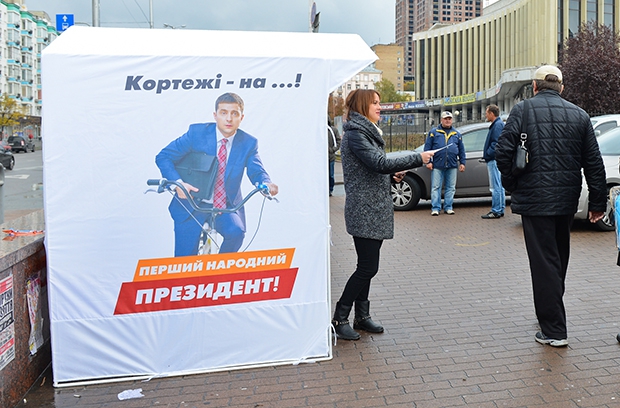
Cortege to the …! The first people’s president!
Photo: Передвиборча агітація

Kazimir Malevich (1928-1932)
Source Wikipedia
Pablo Picasso was a staunch supporter of the Popular Front (Frente Popular) and its politics. As early as 1936, Picasso had been commissioned by the Spanish government to create an image for the Spanish pavilion at the 1937 World Exhibition in Paris. After the attack on Guernica, he discarded his original image idea of “Painter and Model”.
“It is my wish to remind you that I have always been and still am convinced that an artist who lives and works with spiritual values cannot remain indifferent in the face of a conflict in which the highest values of humanity and civilization are at stake.”
– Pablo Picasso: December 1937.

Pablo Picasso (1937)
Source Wikipedia
Picasso’s “Guernica” is an illustrative image that creates a transition between the first and second forms of penetration. This image is not only a narrative reminder of “the highest values”, but also a form of art therapy.
During the First World War, psychologists noticed that many soldiers began to draw or paint of their own accord. During the Second World War, mainly in Great Britain and the USA, artists and psychologists were recruited to work with soldiers who had been traumatized by war experiences. There are also countless examples of exhibitions of therapeutic works by artists and the military during the Russian-Ukrainian war.
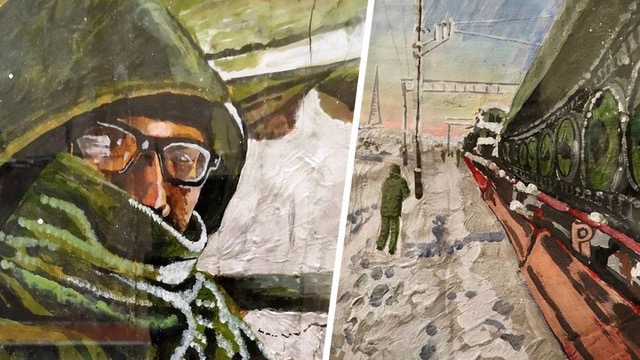
Kharkiv Historical Museum 2020
In the second form of penetration, politics bears responsibility for the creation of therapeutic works in the media of painting or drawing as well as in the medium of the image.
Piet Mondrian’s art was part of the Degenerate Art exhibition in 1937. For this exhibition, works of art were confiscated from museums all over Germany for propaganda purposes because they did not fit in with the ideology of the Nazi dictatorship.
As early as 1938, the threat of war also prompted Piet Mondrian to flee from Paris to London. He emigrated to New York via Great Britain at the end of 1940. In the same year, Mondrian wrote a text entitled “Art Shows the Evil of Nazi and Soviet Oppressive Tendencies”, which he later changed to “Liberation and Oppression in Art and Life”.
Mondrian’s last painting is called “Victory Boogie Woogie”. Mondrian painted “Victory Boogie Woogie” during the Second World War in New York. When he died in early 1944 at the age of 72, the work was unfinished. What is special about this painting is that Mondrian distanced himself from his earlier neoplastic ideas in order to achieve a balance in the composition through the dynamic rhythm. There is no direct evidence that Piet Mondrian wanted to give his last painting precisely this title. It can be assumed that the title “Victory Boogie Woogie” was given by James Johnson Sweeney, an American curator and author on modern art. “Victory” in the title was intended to allude both to the expected victory of the Allies in the Second World War and to Mondrian’s overcoming of the earlier strict compositions in favour of the new rhythmization of the motif.
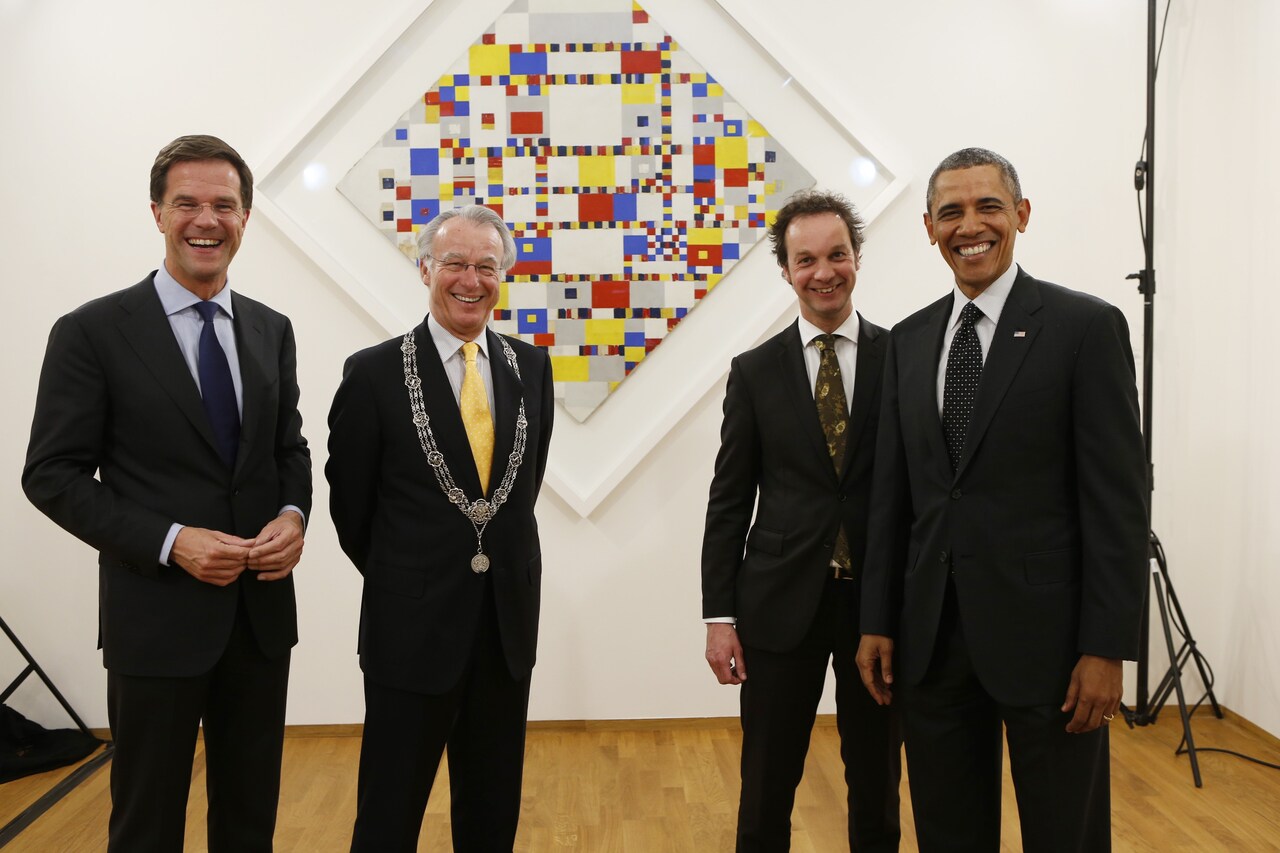
The Netherlands acquired the painting in 1997 with funds from De Nederlandsche Bank for 37 million euros from the American newspaper magnate S.I. Newhouse. Since then it has been on loan to the Gemeentemuseum in The Hague. Hans Locher, director of the Gemeentemuseum at the time, commented on the new acquisition: “Victory Boogie Woogie is the triumphant response to the Second World War. Picasso’s famous Guernica has become the image par excellence for violence and war casualties in the twentieth century. Now, Victory Boogie Woogie by Mondrian is the image par excellence for the victory of joie de vivre and freedom”.
While Manet, Degas and Renoir went off to fight in the Franco-Prussian War (1870-1871), Monet and Pissarro fled to London. Cézanne moves to L’Estaque, near Marseille. Although Cézanne was denounced as a deserter in January 1871, he managed to hide successfully.

Paul Cézanne (1896)
Source Wikipedia
In 1898, in conversation with Joachim Gasquet, the French painter expresses his views:
… People only speak well of painting in front of paintings. Nothing is more dangerous for a painter, you know, than to get involved with literature. If he falls for it, then he’s finished. …
… A painting represents nothing, should initially represent nothing but colors…
In 1918, Lenin suggested erecting monuments to the heroes of the world revolution; Courbet and Cézanne were on the list of honorees.
Oleksiy Koval
Munich, June 24, 2024
 Oleksiy Koval
Dear Oleksiy this is an excellent thought provoking, well researched and relevant essay. Giving insights into how artists have historically responded in contradictory and divergent ways to conflict. Congratulations ! There is information here I did not know and I suspect most other artist will not be aware of, e.g.The naming of Mondrians work. Politics is always seeking to hijack art to its own purposes which needs to be resisted. Art like religion becomes toxic when it works hand in hand with the powers of the state. It’s the independent life of art which asserts the necessity of the freedom of independent practice. When Matisse was challenged as to why he made no paintings in response to two world wars he articulated that the role of art was to remind human beings of the positive human power of creativity as the counterpoint to the degrading depravity of war.
With a hug
Michael
LikeLike