
“The Last Supper” (between 1592 and 1594)
365 cm x 568 cm, oil on canvas
San Giorgio Maggiore, Venice
“He penetrated deep into this world of flames, where the smoke of our earth grows pale… I see him… I see him. The light detached itself from evil. And at the end of his life he confessed, he whose palette rivalled the rainbow, that he loved only black and white… His daughter was dead… Black and white!… Because colours are evil, because they torment, do you understand… I know this pain.”
– (Michael Doran, ed., “Conversations with Cézanne”)
A monkey unexpectedly receives juice and its dopamine neurons fire strongly. The monkey learns: a light signal announces the juice — and its dopamine neurons now release at the light signal, no longer at the juice itself. The light signal appears, but the juice does not arrive — the monkey’s dopamine neurons are actively suppressed and fall below the baseline level.
Dopamine is a chemical messenger that transmits signals between nerve cells. Dopamine neurons are neurons whose messenger substance is dopamine. The entire human brain has only approximately 400,000–600,000 of them, out of ~86 billion neurons in total. Their effect is nevertheless enormous, because a single dopamine neuron can simultaneously modulate thousands of other neurons via its branching axon (a long nerve cell extension that conducts electrical impulses away from the cell body to other cells).
In the 1980s and 90s, Professor Wolfram Schultz investigated dopamine neurons in monkeys using electrodes in the brainstem. The conclusion of the German-British neuroscientist’s experiment was revolutionary: dopamine does not encode reward — it encodes the deviation from expectation. This is the Prediction Error.
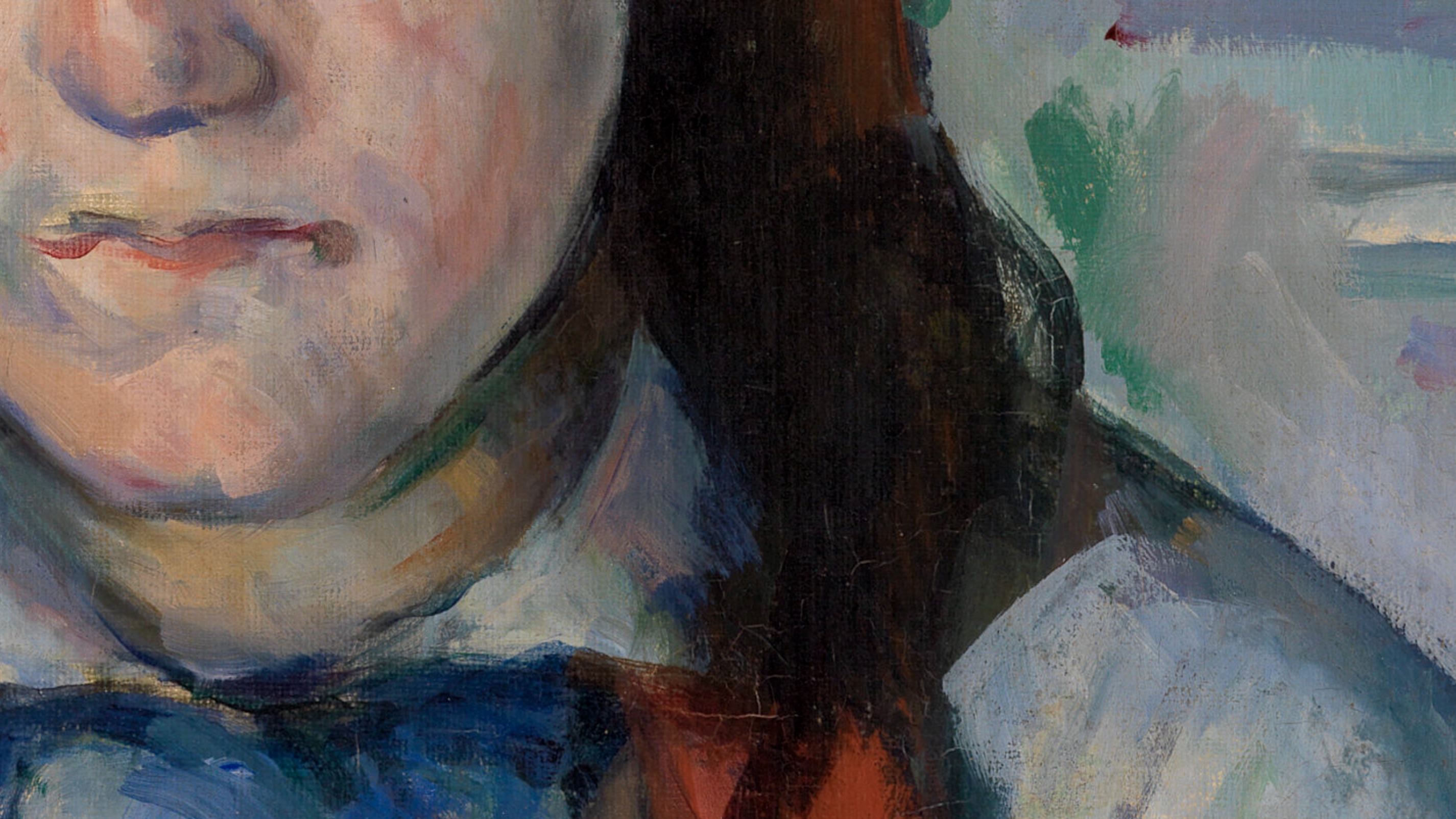
“Le Garçon au gilet rouge” (1888–1890), detail
65.4 × 54.6 cm, oil on canvas
Barnes Foundation, Philadelphia
Light is electromagnetic radiation with various wavelengths. Different wavelengths enter the eye and pass through the cell layers of the retina. The retina is a paper-thin layer on the inner wall of the eyeball. It consists of ten layers — but the rearmost layer, where photoreceptors with rods and cones are located, may well be responsible for the fact that people still confuse painting or drawing with an image. Compared to squids and octopuses, the photoreceptors in the human eye were installed the wrong way around. The consequence of this is that a blind spot arises during the passage through the cell layers of the retina. Specifically as follows: the waves enter through the cornea, are focused by the lens, then strike the rods and — in men — three cones: for short, medium and long waves; in women often even four cones: the fourth falls between medium and long waves. Rods and cones convert wavelengths into electrical signals. The signal continues through bipolar and ganglion cells to the optic nerve — and it is precisely at this point that a blind spot arises: the ganglion cells there have no photoreceptors behind them. The so-called blind spot must be filled in by the brain, which calculates what is “probably” there.
Ganglion cells are the final layer of the retina — and at the same time the first step of the brain. Ganglion cells are not passive cables. Each ganglion cell has a receptive field — a specific area of the retina to which it responds. The brain receives ~1.2 million parallel data streams that are already pre-processed — sorted by contrast, movement, edge position and wavelength. It is a highly compressed, already interpreted feature report.
The brain does not process visual information in a single location, but rather in a hierarchy of specialised areas in the visual cortex. These are numbered: V1, V2, V3, V4, V5. V1 — primary visual cortex, directly behind the skull. This is where the retinal signal first arrives. V1 registers edges, orientations, contrasts; V2, V3 — further pre-processing, form extraction. It is only in the V4 area that colour arises as a conscious quality. Here the opponent signals become what we experience as colour sensation. V4 is also involved in form perception and object recognition — colour and form are brought together here. V5 — specialised in motion.
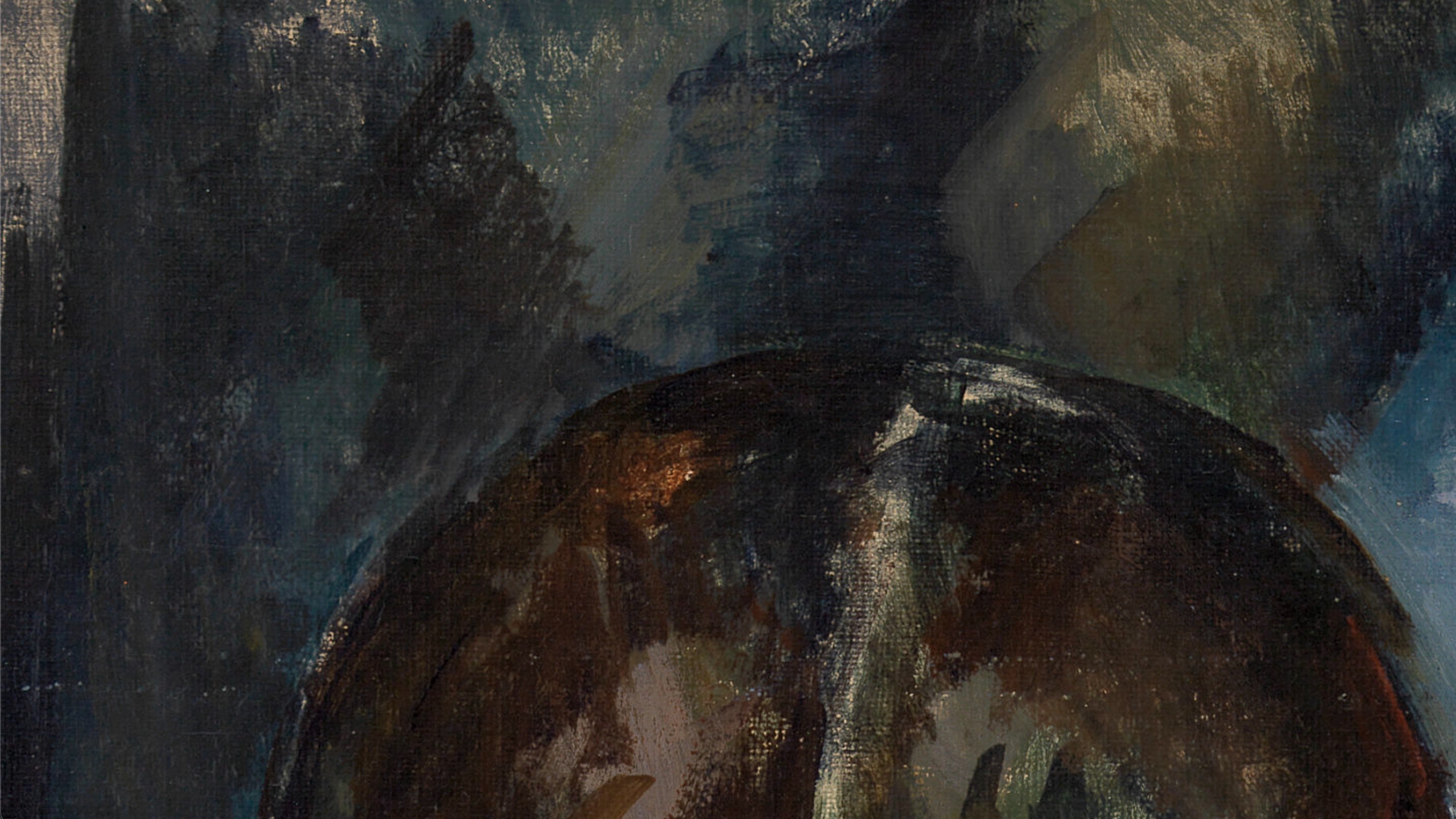
“Le Garçon au gilet rouge” (1888–1890), detail
65.4 × 54.6 cm, oil on canvas
Barnes Foundation, Philadelphia
But colour is a product of V4. Colour is not a property of the environment — it is a construction of the brain. Colour is a metaphor — a language developed over millions of years of evolution to distinguish surfaces, materials and lighting conditions. It is useful, precise — but it is not out there. What is out there: wavelengths, energies, reflections. What is in consciousness: red, blue, magenta, brown — a complete, coherent, constructed world. The model is never finished, never static, never an image. It is a continuous process — continuously updated by new retinal signals, continuously corrected by expectations and predictions.
The brain consumes approximately 20% of the body’s total energy expenditure — at only 2% of body weight. To conserve energy, the brain has developed a radical solution: it does not process what is there — it sends predictions downward and processes only the deviations. This is the Predictive Coding model:
Top-Down: “I expect X.”
The brain sends predictions downward into the sensory cortex even before a signal arrives. What we perceive is less “what is there” than “what we expect to see.” If the prediction is correct, then Prediction Error = 0. The brain stops working — everything is as expected, no signal transmission necessary, energy saving.
Bottom-Up: “But it is Y.”
The error is propagated upward.
The sentence “because colours are evil, because they torment” describes the Prediction Error as a permanent state: the painter sees the colours in his imagination (Top-Down), the colour on the surface never fully meets the prediction (Bottom-Up). The pain is the permanent, unsolvable Prediction Error.

